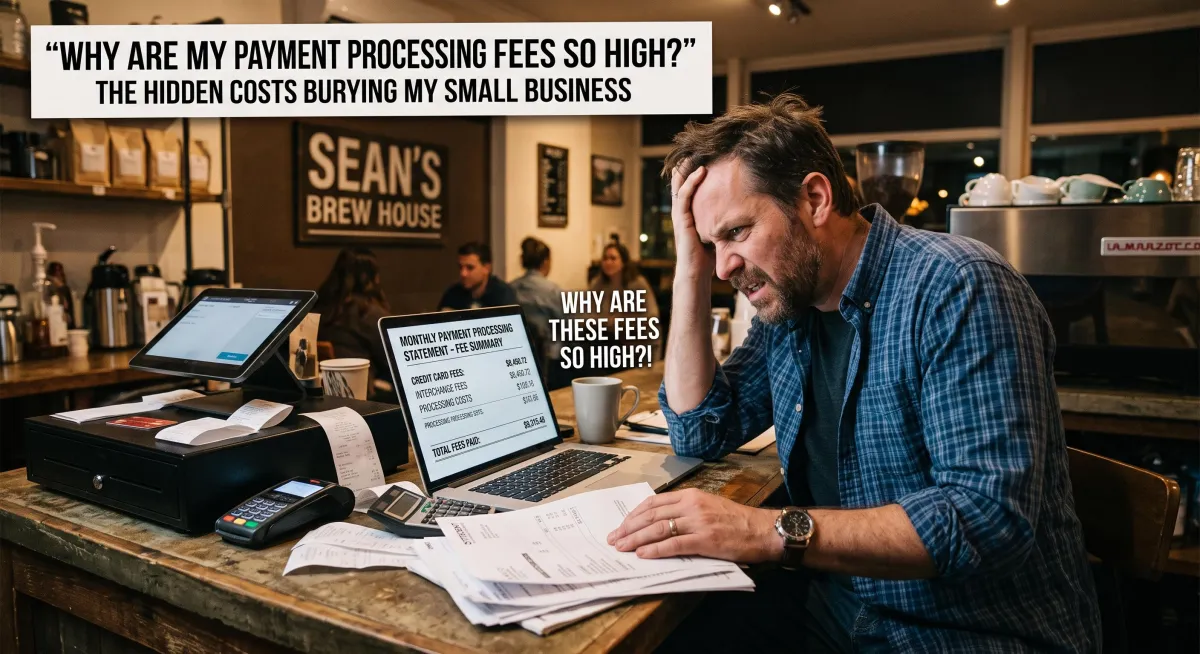
Why Are My Payment Processing Fees So High? (A Payments Guy Explains)
You ran your numbers for the month. You processed a good amount of volume, you're happy with the sales — and then you see what came out in card processing fees.
That number stings. So you type the question into Google: why are my payment processing fees so high?
Most of the people asking are on Square, Stripe, or QuickBooks Payments. They're paying a flat rate — 2.9% + 30¢ on a Stripe online payment, 2.6% + 15¢ on a Square card reader, 3.5% + 15¢ if you key the card in by hand — and it's the same rate on every single sale, every day, forever.
I've been in banking and payments for 21 years. I've reviewed a lot of statements. And I'll be honest — most of the time, the fees aren't high because somebody is cheating you. They're high because of one thing almost nobody explains to a business owner.
Here it is.
You're asking the wrong question
Every week somebody asks me, "Jeff, what's your rate?"
It's the wrong question. The better question is: what's your pricing structure?
That's not me being clever. Those are two completely different things, and the second one is where all the money is.
Here's what I mean.
What's actually inside that "one simple rate"
Visa, Mastercard, American Express, and Discover don't charge one price. They charge hundreds of them.
Visa alone has something like 400 different prices depending on what kind of card it is, what industry you're in, and how the card was taken. A basic debit card tapped at your counter costs almost nothing. A premium travel rewards card keyed in over the phone costs a lot more. A corporate card used for a B2B invoice is priced differently again.
That underlying cost is called interchange. It goes to the bank that issued the card, and nobody — not me, not Square, not anybody — can change it.
Now here's the part that matters.
When you're on a flat rate, you pay 2.9% and 30 cents no matter which card walks in the door. If a customer hands you a plain debit card that only costs about 1% at interchange, you still pay 2.9% and 30 cents. The aggregator keeps the difference.
That's not a scandal. It's the trade — they give you a simple number and instant sign-up, and in exchange they blend everything together and keep the spread.
But once I show a merchant that spread, the reaction is almost always the same. They look at the 1% versus the 2.9% and go, "Oh. Yeah."
The alternative is interchange-plus, sometimes called wholesale pricing. You pay the true interchange cost on each card, plus a small, disclosed markup on top. When a cheap card comes through, you pay a cheap rate.
Just changing the pricing structure — nothing else about your business — typically saves somewhere between half a percent and a full percent.
Want to know what your spread actually is? Upload a statement and we'll tell you free →
What that looks like in real dollars
Two real examples.
A coaching company on Stripe. They were doing close to $100,000 a month in card volume. Nothing exotic — online payments for a program. We moved them off the flat rate onto interchange-plus and they saw about 65 basis points in savings.
Sixty-five basis points is 0.65%. On $100,000 a month, that's roughly $650 a month — around $7,800 a year — for a business that changed nothing about how it takes payments. Same cards. Same customers. Different pricing structure.
A staircase and railing supplier on QuickBooks. This one went a different direction, and it's a good example that price isn't the only lever.
They sell to contractors and builders, and they were getting hit with the QuickBooks flat rate on every credit card invoice. About 80% of their contractors were paying by card, 20% by eCheck — bank-to-bank payments that cost a fraction of what a card costs.
We set them up on dual pricing. Nobody forced anyone to do anything. Contractors just saw both options with honest pricing on each, and they made their own call.
Within a short window the mix flipped: about 20% card, 80% eCheck. The cheapest way to get paid became the way most of their customers paid.
Sometimes the answer isn't a lower rate. It's giving your customers a cheaper way to pay you.
If you sell to other businesses, read this part twice
This is the one I catch most often, and it's the most expensive one to miss.
B2B and B2G transactions qualify for something called Level 2 and Level 3 data. If you pass a few extra fields with the transaction — things like a customer code, tax amount, line-item detail, freight — the card brands charge you a significantly lower interchange rate on corporate, purchasing, and government cards.
The savings on those specific transactions are big. Depending on the card and the data you pass, you're looking at roughly 0.5% to 1.5% lower interchange on qualifying commercial cards. Not a rounding error.
And a huge number of B2B merchants aren't getting any of it, because their gateway isn't set up to pass the data, or nobody ever told them it existed.
If you invoice other businesses and you've never heard the words "Level 3," there's a very good chance you're leaving money on the table on every corporate card you run.
The junk hiding on your statement
Structure is the big one. But there's usually loose change on the floor too.
Annual fees. This is the sneakiest one. It only hits once a year, so it doesn't show up in your mental math of "what do I pay monthly?" You look at eleven clean statements and one ugly one, and you never connect the dots.
Non-PCI-compliance fees. I see merchants who have been paying these for years. Not because they can't be compliant — because nobody ever walked them through the questionnaire. It usually takes about fifteen minutes of education to make that fee go away permanently. Nobody had a reason to tell them, so nobody did.
Monthly minimums. These aren't automatically evil, but they should match your situation. On our standard merchant account there's a $25 monthly minimum. If somebody tells me up front they won't be running much volume, we don't put them on that account — we set them up on what we call a mini merchant with no monthly minimum. That takes one question during the setup call. It only becomes a problem when nobody bothers to ask.
Not sure what you're paying for? Send us two months of statements. →
"My fees went up and nothing about my business changed"
I hear this all the time, and here's the honest answer: somebody probably raised your price.
There are processors — large, well-known ones — that raise merchant pricing twice a year. Not because Visa raised anything. Because they decided to. It shows up as a line of small print on a statement most business owners skim, and then it's just baked in forever.
Some of them go further and build their own margin into what they call interchange, which makes it very hard to tell what you're actually paying versus what the card brands charge.
I know one processor whose founder started his company specifically because of how dishonest his previous employer was about this — locking merchants into contracts with early termination fees and raising prices twice a year without even telling the agents who sold the account.
That's the industry's dirty little habit. Rate creep. It's quiet, it's legal, and it compounds.
When your fees are not too high
I'm going to talk myself out of some business here.
If you're doing under $5,000 a month, stay on the flat rate. Stay on Square. Stay on Stripe.
At that volume the savings from switching are too small to matter. You'd be trading a simple, predictable number with no ancillary fees for a more complex setup that saves you a few dollars. It's not worth your time, and it's not worth mine.
The math starts working somewhere north of $5,000 a month — about $60,000 a year. Below that, the flat-rate aggregators are genuinely the right answer, and anybody telling you otherwise is trying to make a sale.
How to check this yourself
You don't need me to start. Here's the process.
1. Pull at least two months of statements — not one.
This trips people up constantly. On most statements the fees you're billed this month relate to the volume from last month. If you only look at one statement, you're dividing this month's fees by last month's volume and getting a number that means nothing. Two months lets you line it up correctly.
2. Calculate your effective rate.
Take your total fees for the month, divide by your total card volume, and multiply by 100.
$3,200 in fees on $100,000 in volume = 3.2% effective rate.
That one number tells you more than any rate quote ever will, because it includes everything — the discount rate, the per-item fees, the monthly fees, the junk.
3. Know the limit of aggregator statements.
If you're on Stripe, Square, or QuickBooks, here's the frustrating part: they typically show you volume processed and total fees paid, and that's about it. No card-type breakdown.
That means nobody can tell you precisely what interchange-plus would cost you, because we can't see whether you're taking mostly cheap debit or mostly premium rewards cards. Anyone who quotes you an exact savings figure off a Square statement is guessing. We can give you a solid range based on your industry and average ticket, and we'll tell you it's a range.
Or skip the math — book a 15-minute call and we'll walk your numbers together. No strings. →
Three questions to ask before you sign anything
Whoever is pitching you — including me — ask these:
1. Is there a contract?
If yes, walk. There is no good reason to lock a small business into a multi-year card processing agreement in 2026. If a processor needs a contract to keep you, they know they're not going to earn it on service.
2. Are there early termination fees?
Same answer. Walk.
3. Do you ever raise prices?
Not "does Visa raise prices" — Visa does, everybody knows that, and it's out of anybody's control. Ask whether the processor ever raises its own margin. Make them answer it directly. If you get a dodge, or a "well, sometimes market conditions…" — that's your answer.
Get all three in writing.
For what it's worth, that's exactly how we run MerchaMax. Month-to-month. No contract. No early termination fee. And we don't raise pricing on merchants — that's not a promotional rate, that's the deal.
So — are your fees actually too high?
Maybe. Maybe not. Here's the honest summary:
Under $5,000 a month? Your fees are probably fine. Stay where you are.
Over $5,000 a month on a flat rate? You're very likely overpaying by half a point to a full point, and it costs nothing to find out.
Selling B2B and never heard of Level 3? You're almost certainly overpaying.
Fees crept up with no explanation? Somebody raised your price. Go read the small print.
We'll review your statement for free and tell you the truth — including "you already have a good deal, stay put." That happens, and we say it.
There's no setup fee, no consultation fee, and no charge for the review. The only way we make money is if you're processing payments through us, cards or eCheck. If your business grows, we do better. That's the whole model — we're not looking to squeeze you on rate, we're looking to be your processor for the next ten years.
And price isn't really where we win anyway. It's support. If you get a chargeback, you get a real person who shows you how to fight it and how to stop the next one. When you have a question, you call or text — not an 800 number, not a ticket queue.
Upload your statement for a free review →
Book a 15-minute call — no strings attached →
Jeff Glines is the founder of MerchaMax, a payment processing consultancy in St. George, Utah. He spent 21 years in banking and payments before starting MerchaMax to help small and mid-sized businesses stop overpaying to accept cards.


